
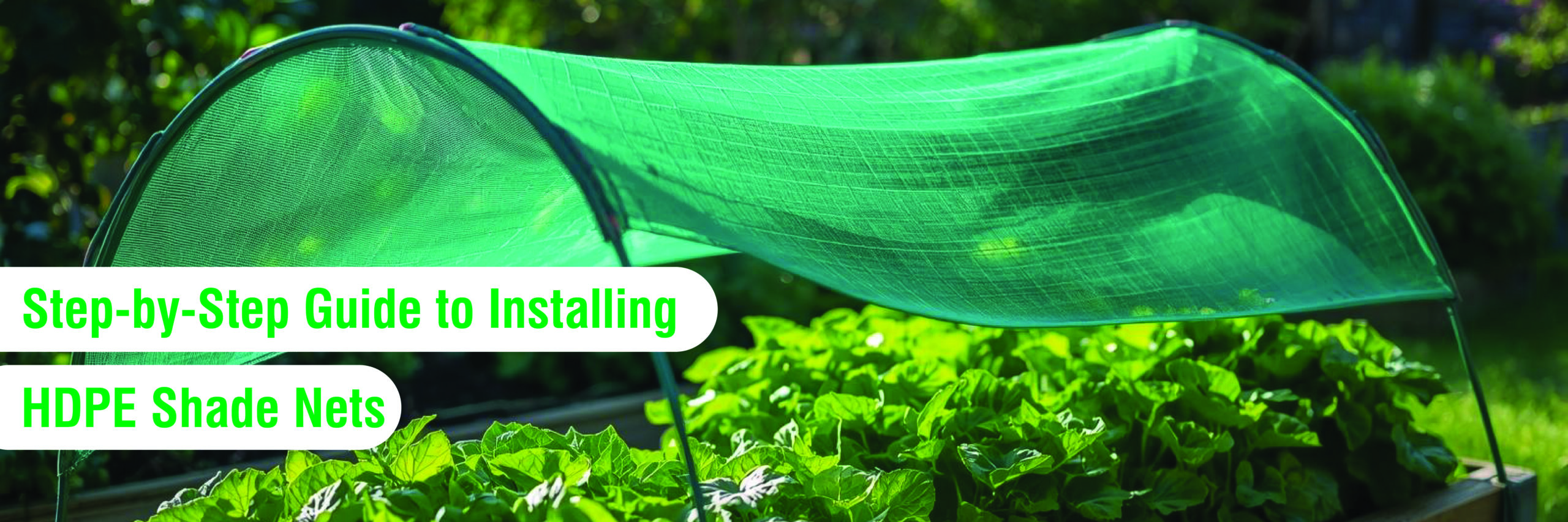
The quality of your HDPE shade net (measured by its GSM and UV stabilization) is only half the equation; the other half is proper installation. A net, no matter how durable, will fail quickly if it is not installed correctly—especially if it sags, flaps, or is inadequately anchored.
This step-by-step guide is designed to walk small and medium-scale farmers through the professional installation of an HDPE shade net structure. By following these instructions, you will ensure maximum tension, structural stability, and longevity for your protected cultivation environment.
Careful planning minimizes errors and material waste during the setup process.
Choose a Level Area: Select a site that is as level as possible to ensure uniform tension on the net.
Clear the Ground: Remove all rocks, debris, and roots. The ground must be clear to prevent damage to the net during unrolling and to facilitate easy post-hole digging.
Determine Dimensions: Accurately measure the length (L) and width (W) of the area to be covered.
Mark Post Positions: Mark the location of the posts. For standard shade houses, posts should be spaced 3 to 4 meters (10 to 13 feet) apart in a grid pattern. Corner and perimeter posts require maximum strength.
Verify Net Specifications: Ensure you have the correct shade percentage (e.g., $50\%$) and GSM (e.g., $150 \text{ GSM}$) for your crops and climate.
Gather Tools: Collect all necessary tools: measuring tape, string/chalk line, post hole digger (or auger), level, hammer, concrete mix (optional but highly recommended), and tensioning hardware (turnbuckles or rope).
The frame must be robust enough to handle the weight of the net, wind loading, and potential rainwater accumulation.
Dig Deep: Dig post holes to a depth of at least 1.5 to 2 feet (45–60 cm). In sandy or high-wind areas, go deeper.
Set Corner Posts: Place the corner posts first. These should be larger or better anchored than the interior posts. Use a spirit level to ensure the posts are perfectly plumb (vertical).
Concrete Anchor (Recommended): Pour a concrete mixture around the base of the posts and tamp it down firmly. Allow the concrete to cure fully (typically 24–48 hours) before proceeding to the next step.
Maintain Consistent Height: Ensure all posts are cut or set to a uniform height (typically 8–12 feet).
Run Top Wires: Connect the tops of the posts by running high-tensile galvanized steel wire or cable horizontally along the perimeter and potentially across the interior (especially for wide spans).
Tension the Wires: Use turnbuckles or heavy-duty wire tensioners at the ends of the perimeter wires to pull them taut. The net will be attached to these wires, so they must be strong and stable.
This phase is critical for ensuring the net is tight and protected from wind damage. It is best done with 2-3 people.
Unroll Carefully: Lay the shade net on a clean, cleared area beside the structure. Avoid dragging the net across rough ground or sharp objects to prevent snags.
Position: Gently lift the net and drape it over the entire support structure. Ensure the net is centered with an even overhang on all sides.
Choose a Long Edge: Start by permanently securing the net along one of the longest side wires/cables. This becomes your anchor side.
Attachment Method: Use UV-stabilized shade net clips or a continuous lacing rope/wire to fasten the net to the top wire. Attachments should be made every 1 to 1.5 feet (30–45 cm) to evenly distribute the tension load.
Pull Taut: Move to the opposite long side of the structure. This is where the net must be pulled firmly. The goal is to remove all wrinkles and slack.
Secure Under Tension: While maintaining tension manually, secure the net to the opposite side wire/cable using the same clips or lacing rope. The net should feel drum-tight—tight enough to resist flapping but not so tight that it strains the posts.
Secure Ends: Attach the net securely to the end posts and wires, pulling out any remaining slack horizontally and vertically.
Ground Anchor: Secure the net along the bottom perimeter. You can fasten it to a ground cable, anchor it with heavy stakes every few feet, or slightly bury the bottom edge in a shallow trench to prevent pests from entering and the wind from lifting the net.
Trim Excess: Carefully cut any significant excess material, leaving enough overlap to fold or secure the edges neatly.
Check for Sagging: Ensure there are no low spots where rainwater could pool. Sagging indicates insufficient tension and must be corrected immediately.
Verify Attachments: Confirm that all clips and ties are securely fastened and that the net is protected from rubbing against any sharp edges on the posts or cables.
Monitor Airflow: Ensure the side walls allow for adequate airflow and ventilation to prevent heat and humidity buildup beneath the net.
A: The main cause is wind damage and fatigue resulting from a net that is not pulled taut enough. A loose net flaps, leading to accelerated material wear and tear along the edges and attachment points.
A: Shade net clips are fast and effective for perimeter attachment. For maximum long-term security, a continuous lacing rope or high-tensile wire woven through the net and around the cable is often preferred, as it distributes tension most evenly.
A: It is recommended to purchase the net cut with an allowance of 1 to 2 feet (30–60 cm) on each side beyond the frame dimensions. This extra material is needed for proper tensioning and to wrap around the support cables.
A: Sagging indicates the net has stretched slightly, or the support wires have loosened. You must re-tension the net immediately. Adjust the turnbuckles on the support wires or re-tie the anchor side to remove the slack before it causes damage.
For more than 5+ years we have been delivering world-class construction and we’ve built many lasting relationships along the way.
© 2025 Premier Polytech All Rights Reserved.