
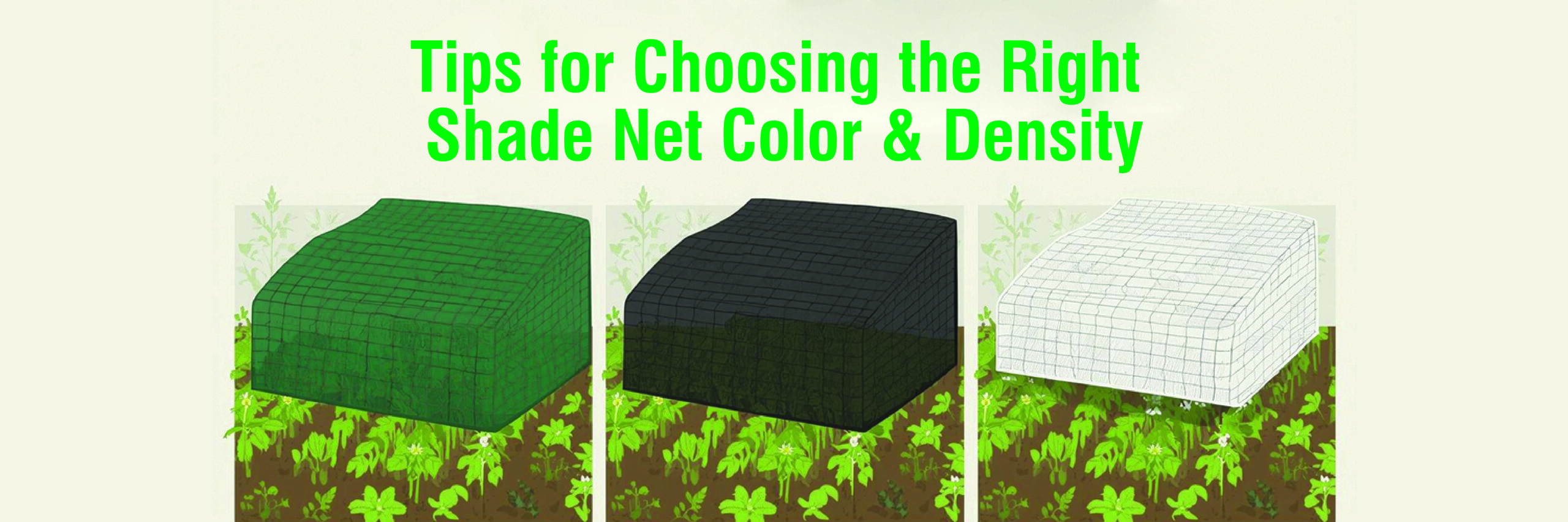
Selecting a shade net involves more than just picking a color that looks good. The right choice requires a scientific understanding of how light impacts plant physiology and microclimate management. The two most critical decisions when purchasing a shade net are the Density (Shade Percentage) and the Color.
Choosing incorrectly can lead to weak, “leggy” plants (too dense) or sun-scorched, stressed plants (too light). Understanding the role of each variable is essential for creating the perfect growing environment for your crops, ensuring maximum yield and quality.
This guide provides clear, practical tips on how to match the right color and density to your specific agricultural or commercial needs.
Density, or shade percentage, determines the quantity of light that is blocked. This is the most crucial decision for crop health.
Plants are broadly categorized by the amount of sunlight they require:
High Light (Full Sun): Most fruiting vegetables (Tomatoes, Peppers), Sugarcane, and robust flowers. Need maximum light penetration.
Medium Light (Partial Sun): Leafy greens (Lettuce, Spinach), Cabbage, and most general nurseries. Need moderate filtering, especially in high heat.
Low Light (Shade-Loving): Orchids, Ferns, Medicinal Herbs, and delicate shade-house seedlings. Require heavy filtering and low light intensity.
| Crop/Application | Recommended Shade Net Density | Rationale |
| Fruiting Vegetables (Tomato, Chili, Cucumber) | 30% – 50% | Reduces heat stress and sunscald without severely limiting photosynthesis required for fruiting. |
| Leafy Greens (Spinach, Coriander) & Nurseries | 50% – 65% | Essential for preventing bolting and leaf scorching; provides the soft, diffused light needed for tender foliage. |
| Orchids, Ferns, & Shade-Loving Ornamentals | 75% – 90% | Mimics a dense canopy environment, providing high shade intensity for plants adapted to low-light conditions. |
| Parking Lots / Livestock Shelters | 80% – 90% | The goal is maximum UV blockage and cooling; light requirements are irrelevant. |
In regions with extreme, persistent heat and high light intensity (like arid deserts), you may need to choose a shade net at the higher end of the recommended percentage range to prevent plant shutdown and heat stress.
The color of the net dictates the quality of light that passes through. Different colors can affect plant morphology, development, and temperature.
Primary Effect: Reduces light intensity and provides maximum cooling by absorbing solar radiation.
Pros: Most durable, highest UV resistance, most cost-effective, and provides the best overall cooling effect beneath the net.
Cons: Can create “deeper” shadows and does not scatter light as effectively as white nets.
Best For: Parking, livestock shelters, nurseries, and general vegetable farming where cost and high durability are priorities.
Primary Effect: Filters light, letting mostly green light pass through, which plants tend to reflect.
Pros: Visually pleasing in a garden setting, often perceived as more natural. It is popular for floriculture and general horticulture.
Cons: Historically, some green dyes have reduced UV stability, though modern nets are generally reliable.
Best For: Home gardens, general horticulture, and plants where a natural aesthetic is desired.
Primary Effect: Reflects a significant amount of solar radiation, resulting in high light diffusion and excellent temperature management.
Pros: The reflected light is scattered more evenly, which can lead to better light penetration into the canopy. Provides superior cooling in extremely hot climates compared to black nets.
Cons: Can be more expensive and may require more frequent cleaning to maintain reflection efficiency.
Best For: Extremely hot, arid regions where cooling is the priority, and for specialized high-value crops (like some flowers) that benefit from highly diffused light.
The shade percentage is the most critical variable affecting photosynthesis and plant health. Focus on selecting the correct density first, then choose the color based on aesthetic preference, specific cooling needs, or budget.
Remember to pair your chosen density with the right GSM (Grams per Square Meter). For a permanent structure or high-wind area, choose a high GSM (e.g., $150 \text{ GSM} +$) regardless of the density, as this dictates the net’s lifespan.
For nurseries, it is common practice to use two different densities: use a $75\%$ net for initial germination, then move seedlings to a $50\%$ net for a period (hardening-off) before transplanting them to the open field.
Always consult local agricultural extension services or experienced farmers in your area. They have empirical data on which shade net densities and colors perform best under specific local climatic conditions and for particular cash crops.
For more than 5+ years we have been delivering world-class construction and we’ve built many lasting relationships along the way.
© 2025 Premier Polytech All Rights Reserved.